

Here’s a scenario that should be keeping CX leaders awake at night: a customer asks ChatGPT to help them resolve an issue with your product. The AI agent navigates to your website, attempts to interact with your chatbot, your search and your digital capabilities. What’s that experience like? Is it successful? Is it secure?
This isn’t a hypothetical future. OpenAI’s Agent is already using websites to execute tasks on behalf of users. Walmart has partnered directly with OpenAI to enable purchases through ChatGPT conversations. The shift is already underway: AI assistants are becoming a new customer segment.
This is one of many topics I explored with Joe Kim, CEO of Druid AI, in a recent VUX World podcast episode. This article, then, is an exploration of what’s driving this change and why it’s accelerating faster than most anticipated. We’ll unpack the two-layer orchestration problem that most enterprises haven’t yet confronted and outline practical steps CX leaders can take now to prepare their digital front door.
Your personal AI assistant has been brewing for years
In 2017, I was dead certain that Amazon Alexa (or something similar) would become the operating system of our lives. I genuinely believed phones would fade into the background. Every interaction, from ordering groceries to checking your bank balance, would flow through this ambient, always-listening layer.
I could see so clearly how Alexa had the potential to become a new distribution platform. If you listened to the radio, it would come through Alexa. If you played games, a growing proportion of your time would be spent on Alexa. Music, shopping, home automation: all flowing through this single interface. With the proliferation of devices running Alexa, from headphones and wearables to microwaves, cars and toilets(!), your personal assistant would be accessible from anywhere. It seemed obvious to me.
Yet it didn’t quite pan out that way.
Alexa’s adoption grew steadily, but it never achieved the platform dominance that Amazon envisioned (or that I anticipated). The technology worked well enough for setting timers and playing music, but it stumbled when tasks required deeper integration. The upstream intent; “I’m planning a camping trip”; rarely translated into downstream action. Even though companies like Best Buy had Alexa skills that technically enable you to buy a TV, the ecosystem remained fragmented, and developing this capability was a big lift in comparison to the usage that followed.
With hindsight, the underlying technology simply wasn’t ready. The natural language understanding was too brittle, the integrations too painful to build, the experience too inconsistent to sustain mainstream adoption for anything beyond the basics.
ChatGPT has the potential to become your personal AI
ChatGPT is different. The adoption curve alone tells part of the story. It reached 100 million users in 12 months. And how people use it is different. 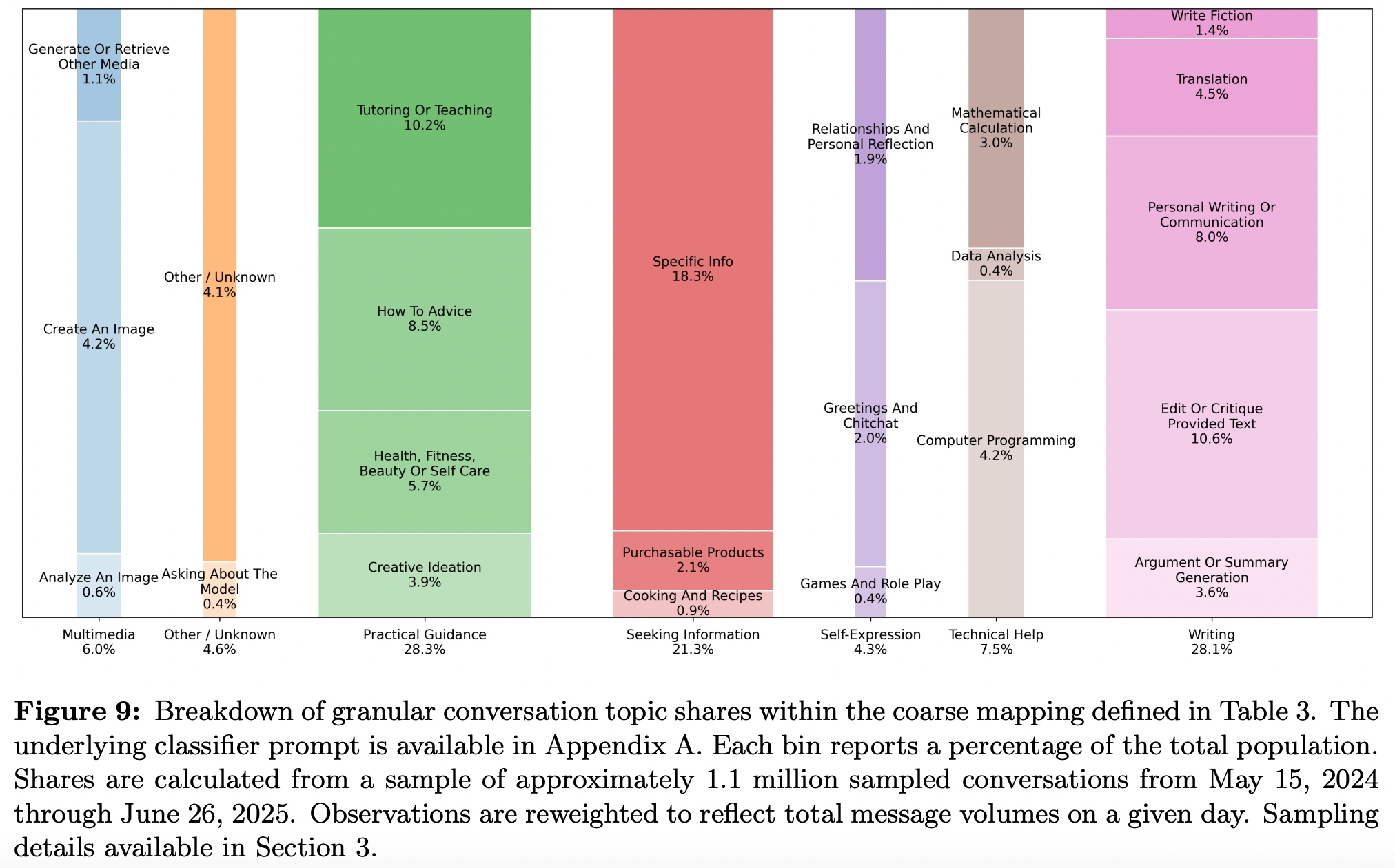
You can see from this study, released by OpenAI, that user behaviour is largely centred around information. However, there’s an emerging segment of action. Writing, coding, analysis, translation, creating images. People’s mental model of ChatGPT is different to Alexa. People are starting to act. And, the underlying technology, crucially, delivers.
OpenAI is actively pursuing these, and building the capability, for more action-oriented use cases. Both in a ‘you come to us’ fashion via the Apps SDK, and its partnership with Stripe, and in a ‘we’ll come to you’ fashion with ChatGPT Agent.

The implication for businesses is significant. We’re at the beginning of a shift in customer behaviour. A shift that will see users devolve more and more of their day to day tasks to AI as AI becomes more and more capable of handling them. And, some of those tasks will involve your business.
AI agents that interact with your business
This is already moving from theory to practice. Kim pointed to a partnership between OpenAI and Walmart, led by Daniel Danker, Walmart’s EVP AI Acceleration, Product and Design.
“You can go to ChatGPT and say, ‘I’m going camping for three days with my two kids and my wife. Tell me what I need.’ It gives you the list. And now, from there, you can directly buy that stuff from Walmart. ‘Would you like to order this from your account?’ It’s already happening.”
This is where the Amazon Alexa comparison breaks down and where CX leaders should pay closest attention. Alexa required brands to build skills, and most didn’t bother. The incentives weren’t there. OpenAI, because of its much larger user base and increased usage, has effectively said ‘come reach our users and, if you don’t, then we’ll go to you whether you like it or not, and whether you’re ready or not’. If you haven’t built an integration via the Apps SDK, then it’ll send an agent to navigate your website like a human would.
The question is no longer whether AI agents will interact with your digital properties. That’s coming. The question is whether this will be a frequent enough occurrence that you should pay attention to it, and if it is, then will the interaction be elegant and controlled, or chaotic and unpredictable? Will it be successful or not?
The orchestration problem: two layers of complexity
Here’s where things get technically interesting, and where most enterprises are woefully underprepared.
When we talk about AI in customer experience today, the conversation typically centres on a single layer: how do we use AI to interact with our customers? It’s a reasonable starting point. You deploy a chatbot, connect it to your knowledge base, maybe integrate it with your CRM so it can pull up order history or do some stuff.
But the emergence of external AI agents (ChatGPT, Gemini, and whatever comes next) introduces a second layer that most organisations haven’t even begun to contemplate. It’s no longer just about your AI talking to your customers. It’s about other AIs talking to your AI, on behalf of customers you may never directly interact with.
This creates what I’ve come to think of as the two-layer orchestration problem that I’ve written about before.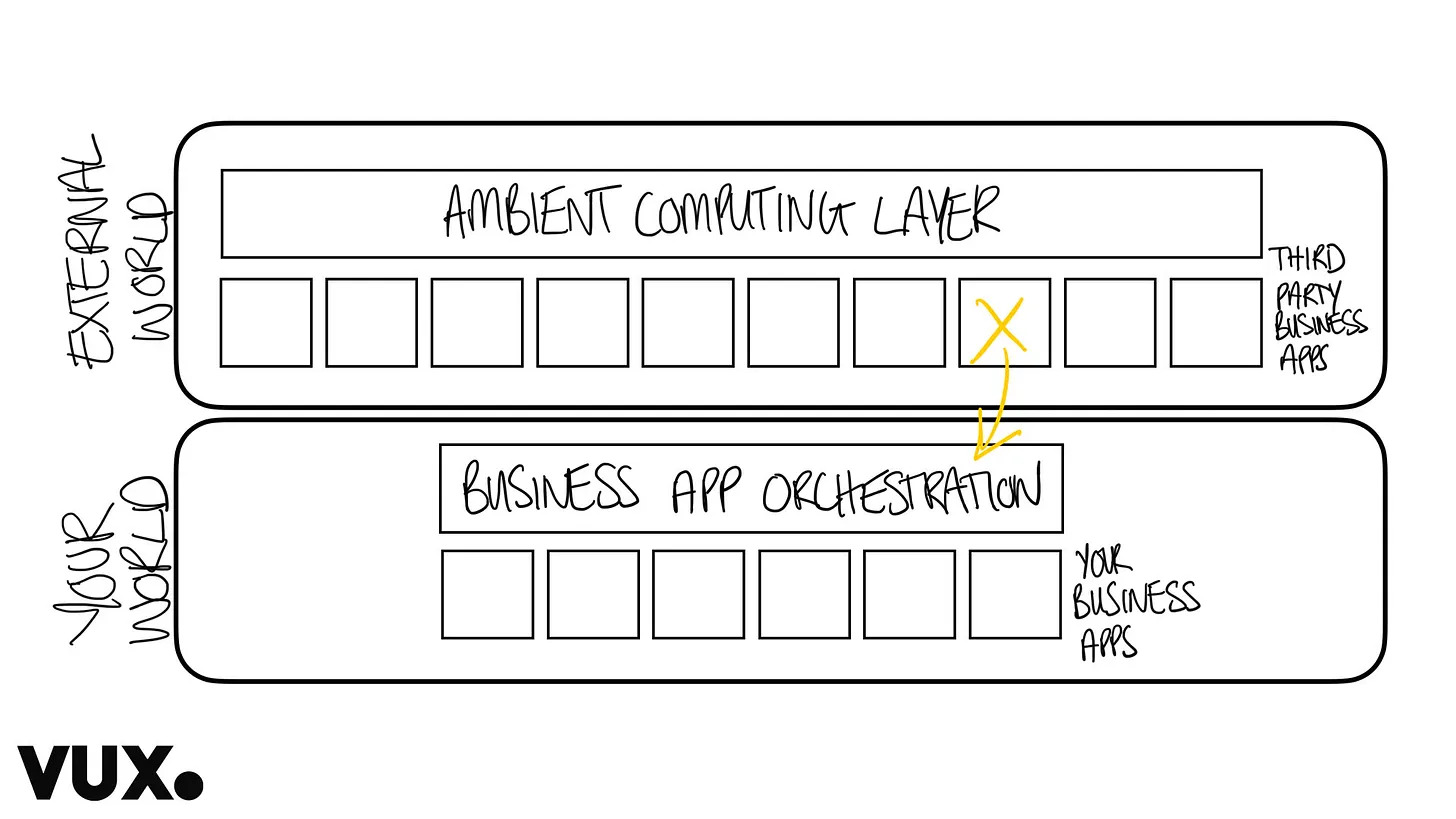
Layer one: internal business orchestration
The first layer is challenging enough on its own. This is the orchestration of your internal systems, workflows, knowledge and data, and bringing them together in a way that allows AI to actually do things, not just answer questions.
Joe Kim described the complexity lurking beneath the surface of even a simple interaction.
“When you log into a website and ask your first question, there’s often 55 different sub-processes, micro-agents, and microservices running in the background before you get that first response. What’s your history? What did you ask last time? What do people like you typically ask? Did we do something internally that might be prompting this contact? What’s the next question you’re likely to ask?”
That’s not a chatbot. That’s an orchestration engine, coordinating knowledge retrieval, customer context, predictive analytics and workflow triggers in real time.
Most enterprises are nowhere near this level of sophistication. They’ve deployed conversational interfaces, but the underlying orchestration remains shallow. The AI can answer frequently asked questions, but it can’t actually resolve issues, execute transactions or navigate complex multi-step processes. Even if they have, it’s deterministic and pre-defined. If ChatGPT’s Agent is anything, it’s not entirely pre-defined.
Layer two: external AI orchestration
Now layer on the second challenge. Even if you’ve nailed internal orchestration; even if your AI can genuinely handle complex customer interactions end-to-end; you now face a new question: how do external AI agents interact with your infrastructure?
When ChatGPT’s Agent visits your website, what does it encounter? A consumer-grade chatbot designed for human conversation? A login wall it can’t navigate? A series of forms optimised for mouse clicks and visual cues that mean nothing to a machine?
The friction points multiply quickly. Your website might be perfectly usable for humans while being essentially opaque to AI agents. Your chatbot might handle natural language beautifully but have no protocol for machine-to-machine communication.
This is the orchestration problem that almost nobody is talking about yet: you don’t just need an AI layer for your customers. You potentially need an AI layer for other AIs.
I’ve explored this two-layer architecture in more depth in a previous piece, but the core tension is this: most enterprises are still struggling to get layer one right. They’re wrestling with integration challenges, accuracy problems and the gap between chatbot demos and production-ready agentic systems at scale. Meanwhile, layer two is already knocking at the door.
Preparing your AI front door: what CX leaders should be thinking about now
If you’re a CX leader reading this and feeling a mounting sense of unpreparedness, let’s translate this into something actionable. The strategic implications are significant, but they mean nothing without concrete steps you can take in the next quarter, not the next decade.
Try this experiment
Here’s a useful experiment: go to ChatGPT, invoke the Agent, and ask it to complete your top three most common customer tasks on your website.
What happens? Does it use your website? Does it use your chatbot? Where does it get stuck?
You can do this today. Watch how the agent navigates. Note which paths it chooses. Observe where it fails and where it succeeds. You’ll learn more in thirty minutes than in any number of strategy workshop, and the results will likely be humbling.
Audit your AI infrastructure for external exposure
Every chatbot in existence was designed for human interaction. The question now isn’t whether your deployment was designed for machines. It wasn’t. The question is: how could you expose its capabilities so that any system could interface with it?
Map the core capabilities your AI can actually execute. Returns. Appointment booking. Each represents a discrete capability sitting behind a human-designed interface.
What would it take to expose these through structured endpoints? Which capabilities are reliable enough to trust without a human in the loop? Those are your candidates for external exposure.
Audit your digital estate
ChatGPT’s Agent doesn’t discriminate between your website and your chatbot. It uses whatever path accomplishes the task. This creates a question most CX leaders haven’t confronted: where do your capabilities actually live, and which channel resolves issues most effectively?
Map capabilities against channels. For each core journey, document where it exists, how well it works and what friction an AI agent might encounter. The goal isn’t perfect consistency, it’s having a clear picture so you can make intentional decisions about where to direct traffic.
Evaluate your orchestration layer
This is where platform selection becomes strategic. You need an orchestration layer that can serve humans and AI agents alike, without being tethered to a single vendor’s ecosystem.
Every tech company on planet earth is adding AI to their products to capture some of this market, but most of them won’t help you in this new world. For example, if your AI capabilities are tied to a specific system, like your CRM or Helpdesk, then that’s not going to cover the breadth of use cases required in future.
Horizontal platforms like Druid, and others, are architecturally positioned differently, designed as orchestration layers from the ground up, agnostic to backend systems. When ChatGPT comes knocking, you need something that doesn’t care whether the request came from a human or a machine, and something that’s not bound to just one of your systems. It needs to connect to all of them. That’s an architectural foundation, not a feature.
Start small, but start
Pick one high-volume customer journey. Run the ChatGPT experiment. Map the capability across your estate. Assess what external exposure would require. The goal isn’t deploying an AI-agent-ready interface next quarter. It’s understanding the gaps and building the instincts you’ll need when this shift accelerates.
The AI Ultimatum
The shift outlined in this article isn’t speculative. OpenAI’s Agent is live. The Walmart partnership is live. AI agents are already attempting to navigate digital estates that were never designed for them. Most enterprises will discover this the hard way, through failed interactions, frustrated customers, and missed opportunities they never see because the AI agent simply moved on to a competitor who was easier to work with.
The organisations that treat this as a future problem will find themselves scrambling. Those that start now, even with a single journey, a single experiment, a single honest audit, will have options when the volume of AI-mediated interactions reaches a tipping point.
So here’s the question worth sitting with: when an AI agent visits your digital front door tomorrow, will it find a capable partner or a locked gate?